PPSC Jobs 2026- Guide to Punjab Public Service Commission Careers
Every year, hundreds of thousands of job seekers across Punjab dream of securing a government position through the Punjab Public Service Commission (PPSC). The promise of job security, attractive salaries, and the dignity of serving the province makes these positions highly sought after.
But here’s the reality: only a fraction of applicants succeed. What separates the successful candidates from the rest? A clear understanding of how PPSC works, what the exam patterns look like, and a strategic preparation plan.
Whether you’re aiming for a prestigious Punjab Civil Services (PCS) officer role or a clerical position in the Prisons Department, this comprehensive guide covers everything you need to know—from the latest 2026 job advertisements to exam patterns, syllabus, and proven preparation strategies.
What Is PPSC? Understanding Punjab’s Premier Recruitment Bo
The Punjab Public Service Commission (PPSC) is the constitutional body responsible for recruiting candidates for various provincial government departments in Punjab, Pakistan . Headquartered in Lahore, the PPSC conducts written examinations, skill tests, and interviews to fill positions ranging from BS-11 to BS-18 across multiple departments.
Think of PPSC as the gateway to a provincial government career in Punjab. Without clearing their selection process, you cannot secure a permanent position in departments like Finance, Prisons, Social Welfare, Agriculture, Education, and many others.
The commission operates under a strict merit-based system. Starting January 1, 2026, PPSC has implemented key reforms: merit will be determined solely based on written examination results and interviews, with additional marks for academic scores, research work, and non-clinical experience being discontinued . This levels the playing field and puts greater emphasis on exam performance.
Latest PPSC Job Openings: Advertisement No. 06/2026
PPSC has released Advertisement No. 06/2026, announcing vacancies across multiple departments. The largest recruitment drive in this advertisement is for the Punjab Prisons Department, with special seats reserved for female candidates .
Here is the complete breakdown of available positions:
| Department | Post Name & Scale | Number of Posts | Qualification Required |
|---|---|---|---|
| Finance Department | Deputy Accountant (BS-16) | 60 | Graduation (2nd Division) |
| Social Welfare & Bait-ul-Maal | Assistant Director (BS-17) | 21 | Master’s in Social Work, Sociology, or related |
| Mines & Minerals | Manager IT (BS-18) | 1 | MCS / MIT / BS (CS or SE) with experience |
| Punjab Transport Authority | Accounts Officer (BS-17) | 1 | M.Com or MBA (Finance) + 1 year experience |
| Industries & Commerce | Assistant (BS-16) / Engineer Lab (BS-17) | 3 | Bachelor’s / B.Sc Electrical or Mechanical |
| Punjab Prisons Department | Junior Clerk (BS-11) | 5 (Female) | Intermediate + Typing Speed |
| Punjab Prisons Department | Junior Computer Operator (BS-12) | 6 (Female) | Intermediate/ICS + 40 WPM Typing |
| Punjab Prisons Department | Junior Accountant (BS-11) | 3 (Female) | I.Com / D.Com (2nd Division) |
| Water Management (Agriculture) | Deputy Director Agriculture (BS-18) | 8 | M.Sc Agricultural Engineering + Experience |
| PPSC Head Office | Junior Psychologist (BS-17) | 1 | Master’s in Psychology (2nd Division) |
Detailed Breakdown of Major Departments
Punjab Prisons Department (Special Seats for Females)
This is a landmark opportunity for female candidates. The department has announced dedicated seats:
- Junior Clerk (BS-11): Requires Intermediate (2nd Division), English typing speed of 35 words per minute, and Urdu typing speed of 25 words per minute. Basic MS Office knowledge is also tested. Age limit: 18-40 years for females .
- Junior Computer Operator (BS-12): Requires Intermediate with a 3-month MS Office diploma or ICS (2nd Division). English typing speed of 40 WPM is mandatory. Age limit: 18-40 years .
- Junior Accountant (BS-11): Open to candidates with I.Com or D.Com (2nd Division). Age limit: 18-40 years .
Finance Department – Deputy Accountant (BS-16)
This position offers 60 seats, with quotas for Open Merit (50), Special Person (1), Minority (3), and Women (6). The qualification is simple Graduation (2nd Division) from any recognized university. The written test consists of a 100-mark MCQ paper covering General Knowledge, Pakistan Studies, Current Affairs, Islamic Studies, Geography, Basic Math, English, Urdu, Everyday Science, and Basic Computer Studies .
PPSC Exam Pattern and Syllabus 2026
Understanding the exam pattern is crucial for success. PPSC follows different patterns depending on the position.
One-Paper Written Test Pattern (For Most BS-11 to BS-17 Posts)
Most PPSC recruitments use a 100-mark objective-type (MCQ) paper with the following structure :
| Aspect | Details |
|---|---|
| Total Marks | 100 |
| Duration | 90 minutes |
| Question Type | Multiple Choice Questions (MCQs) |
| Negative Marking | 0.25 marks deducted per wrong answer |
| Passing Marks | Minimum 40% (40 marks) |
Subjects Covered in the One-Paper Test:
- General Knowledge
- Pakistan Studies
- Current Affairs
- Islamic Studies / Ethics
- Geography
- Basic Mathematics
- English
- Urdu
- Everyday Science
- Basic Computer Studies
Punjab Civil Services (PCS) Exam Pattern
For higher-level positions like the Punjab Civil Services, the exam is conducted in two stages: Preliminary and Mains .
Preliminary Examination (Screening Stage):
| Paper | Subject | Marks | Duration |
|---|---|---|---|
| Paper I | General Studies | 200 | 2 hours |
| Paper II | CSAT (Aptitude Test) | 200 | 2 hours |
Note: There is no negative marking in the Prelims .
Mains Examination (Merit Stage):
The Mains examination is descriptive and all papers count toward final merit:
| Paper | Subject | Marks |
|---|---|---|
| Paper I | English (Compulsory) | 100 |
| Paper II | Essay (English or Punjabi) | 150 |
| Paper III | Punjabi (Compulsory) | 100 |
| Paper IV | General Studies I (History, Geography, Society) | 200 |
| Paper V | General Studies II (Constitution, Polity, Governance) | 200 |
Key difference from UPSC: There are no optional subjects in the PPSC PCS Mains, and language papers (English and Punjabi) count toward final merit .
Specialized Post Syllabus Example: Horticulture Development Officer
For technical positions, the syllabus varies. The PPSC HDO (Horticulture Development Officer) exam follows this pattern :
| Part | Subject | Questions | Marks |
|---|---|---|---|
| Part A | Horticulture | 70 | 280 |
| Part B | General Knowledge & Current Affairs | 20 | 80 |
| Part C | Mental Ability, Reasoning & Quantitative Aptitude | 20 | 80 |
| Part D | Punjabi Language | 10 | 40 |
| Total | 120 | 480 |
There is 1 negative mark for each wrong answer in this exam .
Complete PPSC Selection Process
The selection process for most PPSC positions follows these stages:
Stage 1: Online Application
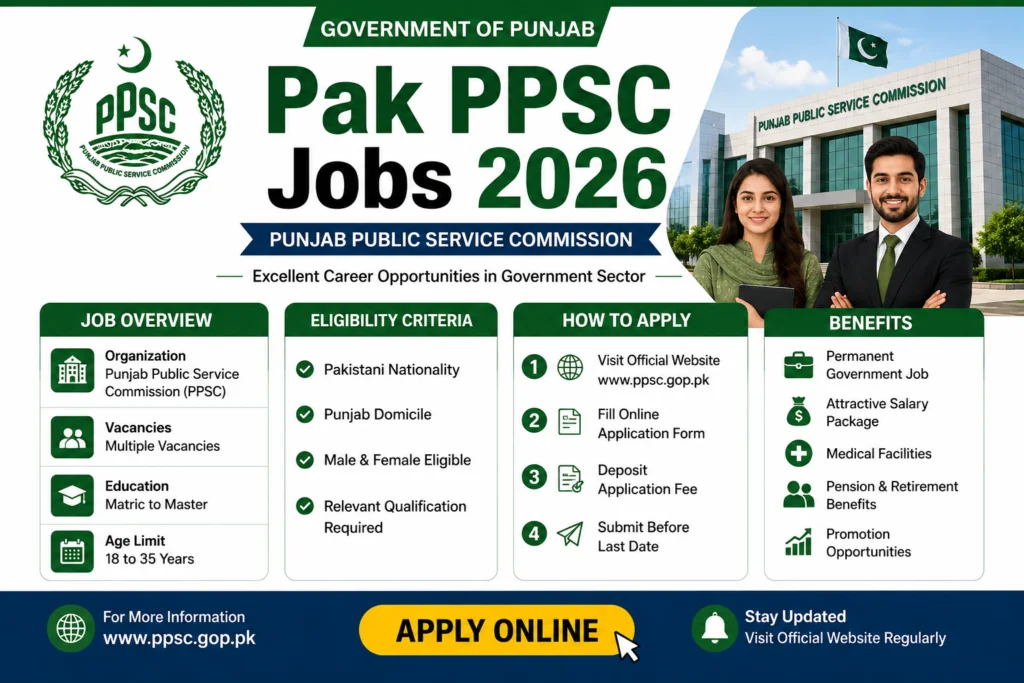
Candidates must submit their applications online through the official PPSC website (www.ppsc.gop.pk) before the closing date mentioned in the advertisement . Applications are only accepted online—hard copies are not required for posts up to BS-18 .
Application fee details :
- One-paper written test: Rs. 600/-
- Competitive examinations (like PCS): Rs. 1000/-
- Special persons: Exempted from fee
The fee can be deposited in any branch of the State Bank of Pakistan or National Bank of Pakistan under the head: “C02101-ORGANIZATIONS OF STATE-TEST FEE REALIZED BY THE PUNJAB PUBLIC SERVICE COMMISSION” .
Important: Bank drafts, pay orders, and cheques are NOT accepted .
Stage 2: Written Examination
The written test is held at designated centers across Punjab. Candidates receive SMS and email notifications about the date, time, and venue, with roll number slips available for download from the PPSC website .
Stage 3: Skill/Typing Test (For Relevant Posts)
For positions like Junior Clerk and Computer Operator, candidates who pass the written test must appear for a skill test :
- Junior Clerk: English typing 35 WPM, Urdu typing 25 WPM
- Junior Computer Operator: English typing 40 WPM + MS Office proficiency test
Stage 4: Interview (Viva Voce)
Candidates who clear the written and skill tests are called for an interview. The interview carries varying marks depending on the position (typically 100 marks for BS-16/17 posts). To pass the interview, candidates must secure at least 50% marks .
Stage 5: Final Merit List
The final merit is prepared by combining:
- Written test marks
- Interview marks
- (No additional academic marks from January 2026 onward)
Candidates are recommended to departments based on their position in the merit list and available quotas.
Important Rules and Instructions for Candidates
Number of Attempts
The number of chances varies by examination type :
- For Competitive Examinations (like PCS): Maximum 3 chances only.
- For One-Paper Written Tests: No limit on chances, provided the candidate obtains qualifying marks (40%) in the written test. However, if a candidate qualifies the written test but fails the interview (fails to secure 50% marks), that chance is still counted as availed.
- For Lecturer Positions: Candidates applying for multiple subjects get 3 chances in each subject .
Eligibility Criteria
Eligibility is determined based on the closing date of application submission. The following documents in original (with two sets of photocopies) are required at the interview stage :
- Matriculation certificate (showing date of birth)
- Intermediate certificate
- Bachelor’s degree with detailed marks certificates
- Domicile certificate of a district in Punjab
- Valid CNIC
- Departmental permission certificate (for government servants)
- Experience certificates (if required)
- Original fee receipt
- Special person certificate (if applicable)
Important Warning: Candidates are admitted to written examinations provisionally. If found ineligible at any stage, candidature will be rejected regardless of written exam performance .
How to Prepare for PPSC Exams: Proven Strategies
Success in PPSC exams requires a structured approach. Here’s a comprehensive preparation strategy.
1. Understand the Syllabus Thoroughly
Start by downloading the official syllabus for your specific post from the PPSC website. The syllabus is your roadmap—don’t waste time on topics not listed.
For PCS aspirants, the syllabus covers :
- Everyday Science: Physics, chemistry, biology concepts and applications
- Environmental Studies: Climate change, biodiversity, pollution
- Indian/Polity: Constitution, Panchayati Raj, elections
- History: Indus Valley to modern India, with special focus on Punjab
- Economy: Five-year plans, LPG reforms, current challenges
- Geography: Physical, human, and economic geography of India and Punjab
- Punjab-specific topics: History, culture, economy, geography
2. Master the NCERTs First
For General Studies preparation, NCERT textbooks (Class 6-12) provide a strong foundation . Link what you learn to specific PPSC syllabus topics, especially Punjab-specific sections.
3. Follow a Structured Study Plan
A 12-month study plan for PPSC preparation typically includes :
| Months 1-3 | Build foundation in General Science, History (Ancient & Medieval), Geography, and Polity basics |
|---|---|
| Months 4-6 | Focus on Modern History, Sikh Gurus, Art & Culture, Economy, and start answer writing practice |
| Months 7-9 | Deepen understanding of Punjabi language, Science & Technology, and take weekly mock tests |
| Months 10-12 | Intensive revision, full-length mock exams, and focus on weak areas |
4. Practice Active Recall and Answer Writing
Instead of passive reading, actively recall key concepts. For Mains, regular answer writing practice is essential . Practice writing essays and descriptive answers under timed conditions, incorporating Punjab-specific examples.
5. Stay Updated on Current Affairs
Dedicate at least 30-45 minutes daily to current affairs. Focus on :
- National and international events
- Punjab-specific news (agriculture, politics, culture, development schemes)
- Government policies and schemes
- Economic developments
Connect current affairs to relevant syllabus topics.
6. Use Technology for MCQ Practice
Mobile apps and online platforms offer subject-wise MCQs, mock exams, and progress tracking . Practice regularly to improve speed and accuracy, paying attention to the negative marking aspect.
7. Simulate Exam Conditions
Take full-length mock tests in a simulated exam environment. This builds time management skills, reduces exam anxiety, and helps identify weak areas .
8. Prepare for the Punjabi Language Paper
For PCS and many other PPSC exams, Punjabi is a compulsory subject that counts toward merit. Focus on :
- Grammar and vocabulary
- Comprehension and precis writing
- Essay writing
- Punjabi culture and history
- Synonyms and antonyms
9. Interview Preparation
The interview can make or break your selection. Prepare by :
- Knowing your educational background and optional subjects thoroughly
- Staying updated on current affairs
- Practicing mock interviews with friends or mentors
- Speaking confidently and clearly
- Being honest about what you don’t know
Frequently Asked Questions (FAQs)
1. What is the application fee for PPSC jobs?
For most one-paper written tests, the fee is Rs. 600/-. For competitive examinations like the Punjab Civil Services (PCS), the fee is Rs. 1000/-. Special persons are exempted from paying any fee. Fees can be deposited online via 1Bill (JazzCash, EasyPaisa, or internet banking) or at State Bank of Pakistan/National Bank of Pakistan branches .
2. Is there negative marking in PPSC exams?
Yes, for most written tests. Typically, 0.25 marks are deducted for each incorrect answer. However, the Preliminary Examination for PCS has no negative marking . Always check the specific advertisement for the exam pattern.
3. How many attempts are allowed for PPSC exams?
For competitive examinations (like PCS) : Maximum 3 chances. For one-paper written tests: No limit, but each attempt where you qualify the written test counts as a chance, even if you fail the interview .
4. Can I apply for multiple PPSC posts simultaneously?
Yes. You can apply for multiple posts if you meet the eligibility criteria for each. However, you must submit separate applications and pay separate fees for each post. For Lecturer positions, candidates get 3 chances in each subject .
5. What documents are required at the time of interview?
You need to bring the following original documents along with two sets of photocopies:
- Matriculation and Intermediate certificates
- Bachelor’s degree with detailed marks certificates
- Domicile certificate of a Punjab district
- Valid CNIC
- Original fee receipt
- Departmental permission certificate (for government employees)
- Experience certificates (if required)
- Special person certificate (if applicable)
Note: All documents must be issued on or before the closing date of application submission .
6. What is the age limit for PPSC jobs?
Age limits vary by post. General age limits are:
- Male candidates: 18-35 years (with general relaxation up to 38 years for certain categories)
- Female candidates: 18-38 years (includes general relaxation)
- Special persons: Additional relaxation as per government rules
Age is calculated as of January 1st of the year of examination .
7. How can I check my PPSC exam result?
PPSC uploads all results on the official website (www.ppsc.gop.pk). You can check your result by entering your CNIC or application number. Candidates are also notified via SMS and email .
Conclusion: Your PPSC Journey Starts Today
Securing a government job through PPSC is undoubtedly challenging. Thousands of qualified candidates compete for a limited number of positions. But remember: every successful officer, clerk, and director started exactly where you are now.
The difference is preparation—not just hard work, but smart, strategic work. Understand the exam pattern inside out. Know the syllabus thoroughly. Practice relentlessly with mock tests. Stay updated on current affairs, especially Punjab-specific developments.
And most importantly, do not let the fear of competition stop you from applying. The new merit system announced for 2026 puts greater emphasis on exam performance and less on academic background . This levels the playing field and gives every dedicated candidate a fair chance.
So visit the official PPSC website today, find a vacancy that matches your qualifications, and take that first step toward your government career. With the right strategy and consistent effort, success is within your reach.